
EUL EUL
EUL32: EnOcean interface for USB and Wi-Fi (TCM 515 + ESP32-C6), Ethernet via expansion board — freely programmable, more than a serial-to-USB bridge.
EUL32 — EnOcean interface for USB and Wi-Fi
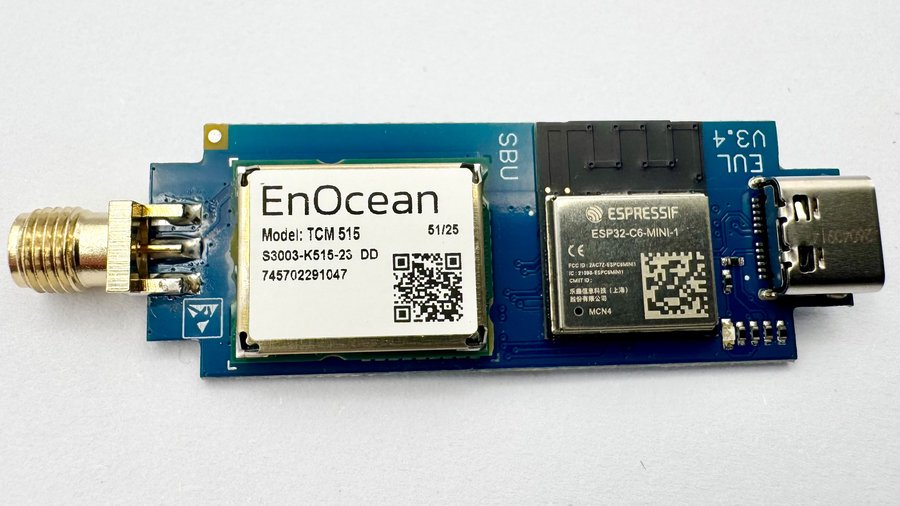
General
The EUL32 connects EnOcean radio in the 868 MHz band to a computer via USB, or to an IP network via Wi-Fi; Ethernet is available through an expansion board. An EnOcean TCM 515 does the radio, an ESP32-C6 sits between it and the host — so this is not just a serial-USB bridge like many other EnOcean USB devices: what it does is decided by the firmware you install.
It ships without firmware, and as delivered it does not transmit — without firmware the TCM 515 is held in reset. It is a bare circuit board without enclosure, meant for DIY use, and comes without an antenna (see below). It replaces the old TCM310-based stick.
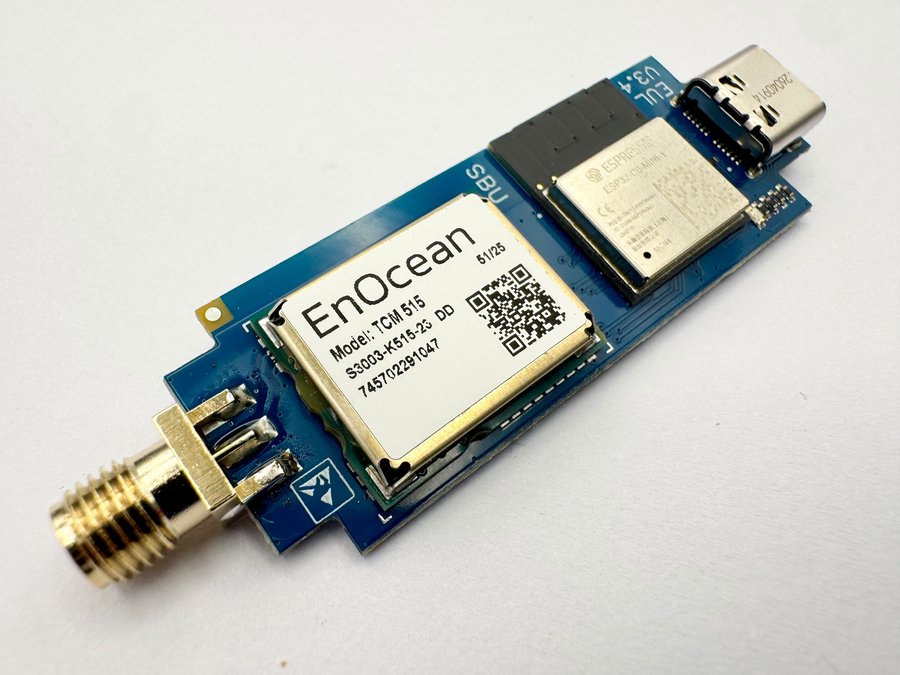
Specs
From the datasheet (Rev. 1.2):
- EnOcean TCM 515: 868.300 MHz, ASK, 125 kbit/s, ESP3 interface; transmit power at most +10.8 dBm, duty cycle ≤ 1 % enforced by the module in hardware
- RP-SMA socket for an external 868 MHz antenna (not supplied)
- Espressif ESP32-C6-MINI-1-H4: Wi-Fi 6 (802.11b/g/n/ax, 2.4 GHz), Bluetooth LE 5.3, IEEE 802.15.4; 4 MB flash; PCB antenna in the module
- USB-C: power, serial port and firmware installation over one cable
- expansion connector J2 (14-pin FPC: SPI, GPIO, power), e.g. for the W5500EXT Ethernet expansion
- blue LED (firmware-controlled), push button “BOOTLOAD”
- board revision V3.4, bare board (IP00), 54.0 × 19.0 × 7 mm, 7 g; dry indoor locations, 0 … +40 °C
Options
Available in the shop (not part of the datasheet):
- plastic enclosure, USB cable
- Ethernet extension
- Ethernet extension with PoE: IEEE 802.3af, Class 0 (RT9400 PoE module, 36–57 V input)
Antenna
The antenna socket is RP-SMA (reverse polarity) — a plain SMA antenna does not fit. Connect a passive 868 MHz antenna of approx. 50 Ω (VSWR ≤ 3:1 recommended). For the gain, EnOcean’s TCM 515 user manual (v1.22, section 12.1, given there as guidance for EU radio approval) names at most 0 dBd, i.e. about 2.15 dBi; EnOcean certified the module with a simple whip antenna. Without an antenna there is no EnOcean reception.
Documents
Datasheet and operating instructions for the EUL32 (article no. EUL32-OEM, board revision V3.4), Rev. 1.2 of 2026-09-26:
- Datasheet: English (PDF) · German (PDF)
- Operating instructions: English (PDF) · German (PDF)
Further references:
Firmware
Every variant is flashed from the browser (Chrome, Edge or Opera — they support Web Serial) at the EUL firmware installer — no toolchain, no installation. (The two variants below are what the live installer manifest listed on 2026-09-25; both run on C3 and C6.)
USB-serial emulation
The transparent path: the TCM 515 appears on the host as a serial port (/dev/ttyACMx), speaking ESP3.
With “USB-serial emulation” the TCM 515 transmits only when the software on the computer tells it to, and Wi-Fi stays off.
- Installer: install.busware.de/EUL → USB-serial emulation
- In FHEM:
define ENO2 TCM ESP3 /dev/ttyACM0 - Example code: serial transparent example
EnOcean ↔ TCP bridge (cdc2net)
The TCM 515 on the network, over Wi-Fi or Ethernet: a byte-transparent raw-TCP pipe, so the ESP3 decoding stays on the host. Wi-Fi is set up right after flashing over Improv.
- Installer: install.busware.de/EUL → EnOcean ↔ TCP Bridge (cdc2net)
- Reachable on TCP port 2329 (configurable in the web UI) — in FHEM:
define ENO2 TCM ESP3 <ip>:2329 - Source: github.com/tostmann/cdc2net
Home Assistant
We recommend the enoceanmqtt-addon.
Availability
This unit is available in our shop.