
CUL32 CUL32
CUL32: 868 MHz radio interface for USB and Wi-Fi (CC1101 + ESP32-C6), Ethernet via expansion board — the successor to the CUL, firmware flashed from the browser.
CUL32 — 868 MHz radio interface for USB and Wi-Fi
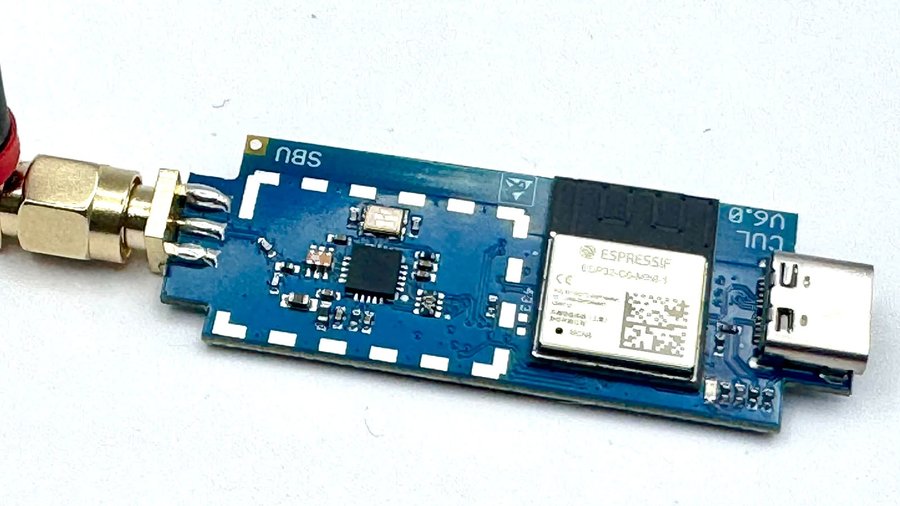
General
The CUL32 connects sub-GHz radio in the 868 MHz band to a computer via USB, or to an IP network via Wi-Fi; Ethernet is available through an expansion board. A TI CC1101 does the radio (FSK and OOK), a freely programmable ESP32-C6 sits between it and the host. It is the successor to the CUL: an ESP32-C6 instead of the ATmega32U4, USB-C instead of a USB-A plug, and Wi-Fi on board.
It is built for 868 MHz only — there is no 433 MHz version. For 433 MHz, the ATmega-based CUL remains available.
It ships without firmware: the CUL32 is OEM hardware, not a finished end product, and flashing the firmware and commissioning it are up to you — see Firmware. It is a bare circuit board without enclosure, meant for DIY use. The base price covers the stick alone; enclosure, antenna, USB cable and an HF shield are options in the shop. The photos show it with an optional antenna.
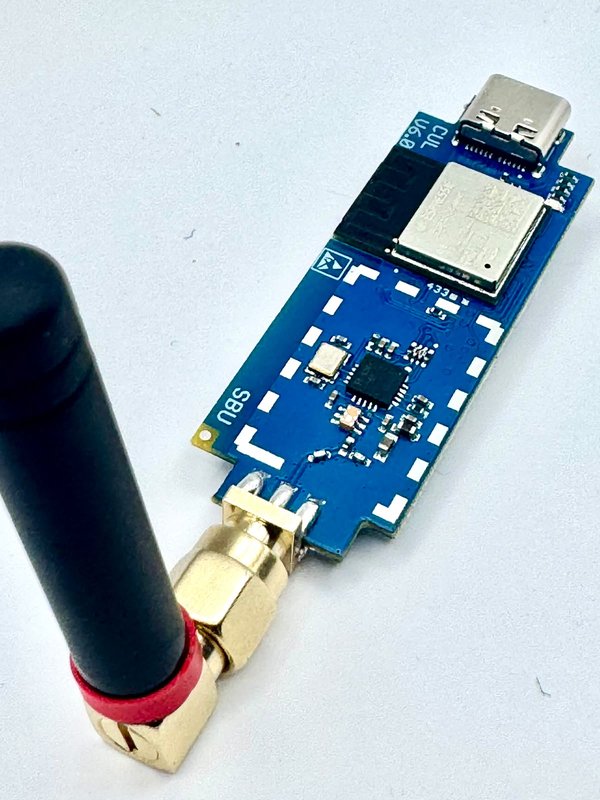
Specs
- TI CC1101 sub-GHz transceiver: 868 MHz, FSK and OOK
- RP-SMA socket for an external antenna (not included in the base price)
- Espressif ESP32-C6-MINI-1-H4: Wi-Fi 6 (802.11b/g/n/ax, 2.4 GHz), Bluetooth LE 5.3, IEEE 802.15.4 (Thread, Zigbee); 4 MB flash; PCB antenna in the module
- USB-C: power, serial port and firmware installation over one cable, through the ESP32-C6’s built-in USB serial/JTAG controller
- UART0 of the ESP32-C6 on the USB-C SBU contacts, e.g. for a second microcontroller — not available while the Ethernet extension is fitted
- expansion connector J1 (14-pin FPC, on the CC1101’s SPI bus) for the W5500 Ethernet extension
- blue LED (firmware-controlled)
- board revision V6.0, bare board
- plastic enclosure, antenna, USB cable, an HF shield and an Ethernet or Ethernet-with-PoE extension are options in the shop; with an Ethernet extension it takes the larger “plastic for Ethernet” enclosure
Firmware
The firmware for the CUL32 is culfw32. It is flashed from the browser (Chrome, Edge or Opera — they support Web Serial) at the CUL firmware installer — no toolchain, no installation: choose 868 MHz CC1101 (CUL32) and the variant culfw32 (FHEM / CUL compatible). Wi-Fi is set up right after flashing over Improv. (This is what the live installer manifest listed on 2026-10-11: one variant, version 0.1.884, for the ESP32-C6.)
culfw32 0.1.884 speaks these 868 MHz protocols:
- HomeMatic (BidCoS) — the classic HomeMatic radio
- HomeMatic IP — receive only: raw frames, not decrypted
- MAX! (eQ-3)
- FS20, FHT, HMS, KS300 and EM (SlowRF, OOK) — not all FHT functions yet
- IT+ and PCA301 — receive only
- fastrf: CC1101 point-to-point link at 250 kbit/s (GFSK)
- Wireless M-Bus, modes T1 and S1 — still pre-release
- Dudette v2 — a radio bootloader for ATmega devices with a CC1101; culfw32 is its counterpart and installs their firmware over the air
On top of that it offers a SIGNALduino-compatible interface for 868 MHz OOK, receive only.
Your own firmware
The ESP32-C6 is freely programmable, e.g. with Espressif’s ESP-IDF, and is flashed over USB-C. The board uses these GPIOs:
- CC1101: CSn GPIO18, SCK GPIO19, MOSI GPIO21, MISO GPIO20, GDO0 GPIO2, GDO2 GPIO3 — SCK, MOSI and MISO are also on J1
- blue LED: GPIO8, active low
- UART0: TX GPIO16 → USB-C SBU1, RX GPIO17 ← USB-C SBU2; both are also on J1
- Ethernet extension on J1: chip select GPIO17 (which is why UART0 is not available with it fitted), interrupt GPIO0
References
- CC1101 transceiver (Texas Instruments)
- ESP32-C6-MINI-1 datasheet (Espressif)
Availability
This unit is available in our shop.